VIKTOR FIALA
- Project Manager
- CZ: + 420 602 423 811
- fiala@incubatoratlanta.com
ONDŘEJ ROLNÍK
- Managing Director
- US: +1 (404) 285-9882
- rolnik@incubatoratlanta.com

SERIES: HOW AND WHERE TO START A BUSINESS IN THE U.S.
When choosing a U.S. state for a first manufacturing or production-oriented market entry, comparing the size of the economy is not enough. A Czech company needs to know where it can hire people reasonably, keep costs under control, serve customers, use logistics efficiently and still keep room for growth. That is why it makes sense to look at states through a scoring matrix.
Our comparison of Georgia, Texas, South Carolina, New York and California shows that the question “Which state is the best?” is too simple. The better question is: which state is the best for the first market entry of a specific type of company?
For Czech manufacturing, processing, technology and production-oriented companies, what matters most is the first-entry logic. In other words, not where the largest economy is, but where a company can most effectively build its first U.S. base. From this perspective, based on long-term statistics and the practical needs of companies, we compared the states across five parameters.
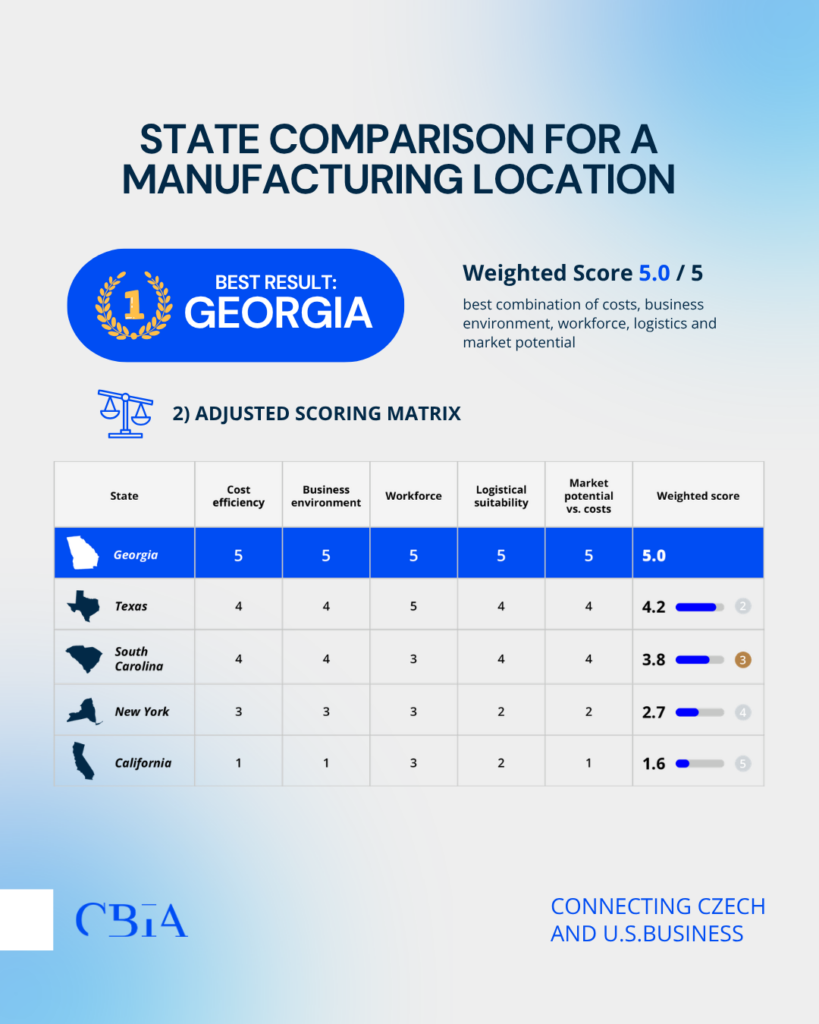
Cost efficiency of market entry carries a weight of 30%. It includes manufacturing wages, industrial electricity prices, tax burden and general operating costs.
Business environment carries a weight of 20%. It looks at tax and regulatory clarity, simplicity of the environment and predictability for companies.
Availability of manufacturing workforce carries a weight of 20%. This is not only about low wages, but also about the size of manufacturing employment and the ability to find relevant people.
Strategic logistics usability carries a weight of 20%. It evaluates how well a state can serve as a manufacturing, distribution and business base.
Market potential versus operating costs carries a weight of 10%. It considers whether the size of the opportunity matches the cost of entering the market.
What the Hard Data Matrix Shows
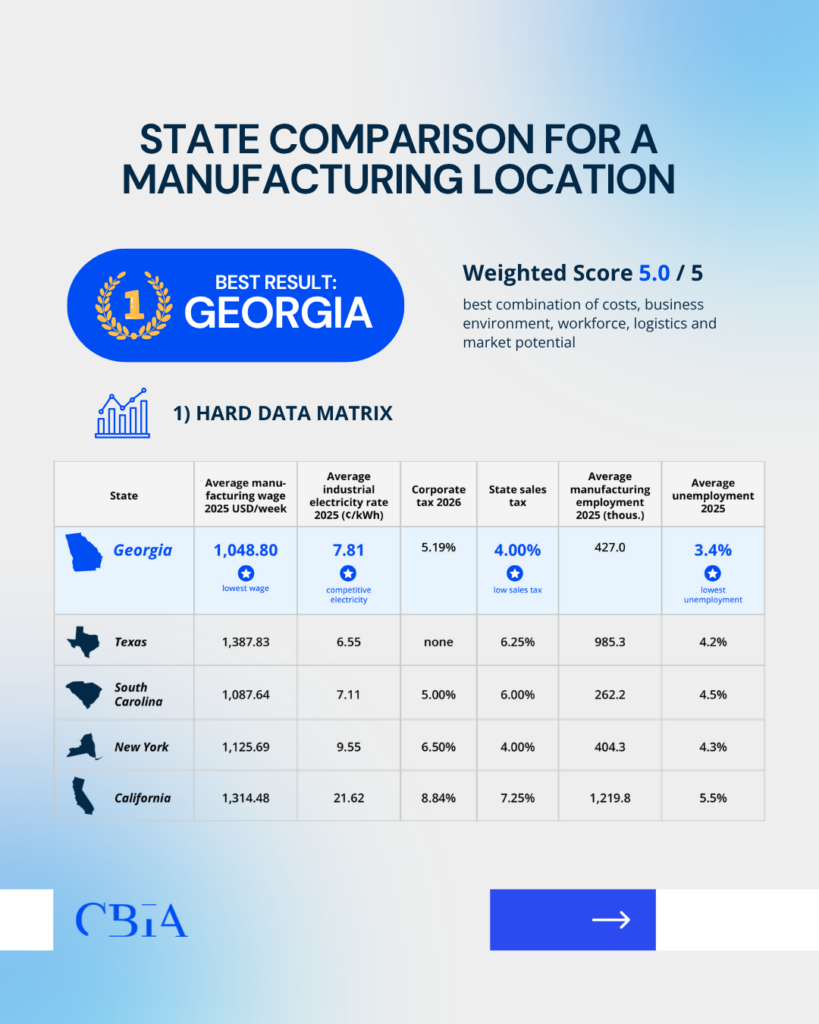
Georgia has a very strong cost profile within the compared group. Its average manufacturing wage is lower than in Texas and California, industrial electricity is competitive, corporate tax is low and state sales tax ranks among the lowest in the comparison.
Texas has cheaper industrial electricity and no traditional corporate income tax, which is a strong argument. At the same time, it has a higher average manufacturing wage and a higher state sales tax.
South Carolina is interesting from both a cost and industrial perspective, but it has a smaller manufacturing workforce base.
New York has a relatively reasonable manufacturing wage, but loses points on electricity prices, overall cost suitability and usability for a first manufacturing entry.
California has the largest manufacturing workforce and enormous market potential, but also very high costs for electricity, wages, taxes and general operations.
The Scoring Result
In the weighted score, Georgia comes out as the strongest state for a first manufacturing or production-oriented market entry. Not because it is the absolute best in every single indicator, but because it is the most balanced.
Georgia scores 5.0. Texas scores 4.2. South Carolina scores 3.8. New York scores 2.7. California scores 1.6.
This result needs to be interpreted correctly. It does not say that Georgia is universally the best U.S. state for every company. It says that, from the perspective of a first U.S. entry for a Czech manufacturing or production-oriented company, Georgia offers the most attractive combination of costs, logistics, labor market, business environment and growth potential.
Why Georgia Wins in This Perspective
Georgia combines several strengths at once. It offers reasonable operating costs. It has a solid manufacturing base. It provides excellent logistics through Atlanta, Savannah, rail connections and the highway network. It is located in the strategically important Southeast region. It also has growing industrial clusters in automotive, aerospace, food processing, logistics and technology.
For a first market entry, this matters. A company does not necessarily need the largest market. It needs a state where it can start, learn, sell, manufacture, distribute and grow without carrying an excessive cost burden from day one.
In this comparison, Georgia works as a practical, cost-effective and logistically strong platform. That is what makes it one of the most convincing candidates for companies that want to enter the U.S. market with a clear plan, not just a famous address in mind.
In fall 2026, CBIA will launch a series of seminars where successful Czech entrepreneurs and our American partners will share the biggest challenges, lessons and practical realities of entering the U.S. market. Subscribe to our newsletter in the footer of our website so you do not miss the invitation.